Charlton Riverside Conservation Area · Royal Borough of Greenwich
Our homes. Our community. Since 1908.
The community website for residents of Derrick Gardens and Atlas Gardens, Anchor & Hope Lane, Charlton SE7.
Active Campaign · 2025 to present
GLi Charlton Gateway: A Proposed Hyperscale Data Centre
A proposed 182 MVA hyperscale data centre on the land allocated for our neighbourhood's future. DAGRA, Charlton Together and CCRA have formally opposed the proposal. No application has been submitted.
Campaign · Neighbourhood Briefing
The GLi Charlton Gateway Proposal — What You Need to Know
A plain-language guide to the proposed data centre, DAGRA's position, and what residents can do. 12 pages.
This is the new home for residents of Derrick Gardens and Atlas Gardens. The notice board is open to all residents. Share news, ask questions, and stay informed.
Welcome
DAGRA Committee · 2 April 2026
Planning
DAGRA submits formal evidence base opposing GLi data centre proposal
Today DAGRA, Charlton Together and CCRA submitted a pre-application planning evidence base to RBG — 22 planning grounds, 52 references, 8 proposed Section 106 obligations.
GLiPlanningCharlton Gateway
DAGRA Committee · 2 April 2026
Community
Could you help us document the history of our streets?
We are looking for old photographs, documents or memories connected to Derrick Gardens and Atlas Gardens. Please get in touch if you can help.
HistoryCommunity
DAGRA · 2 April 2026
Historic photograph
Our History
Our Homes, Our History
Built in 1908 by the coal and lighterage company William Cory & Son, Atlas and Derrick Gardens are among the most historically significant worker housing estates in south-east London.
The estate takes its name from the company's coal trans-shipment operation on the Thames. Floating coal berths called the Atlas and the Derrick unloaded collier ships arriving from the North East coalfields and transferred their cargo into Thames barges. The houses were built to shelter the men who worked them.
The estate was acquired by Greenwich Council in 1983. In 2018 it was formally included in the new Charlton Riverside Conservation Area, a designation our community actively campaigned for.
Community
Share your photographs
We are building a photographic record of Derrick Gardens, Atlas Gardens and the wider Charlton Riverside — past and present. If you have photographs of the estate, the river, the area or the people who have lived here, we would love to hear from you.
All photographs will be credited and displayed with your permission. You can withdraw consent at any time.
About DAGRA: The Derrick & Atlas Gardens Residents Association represents all residents of Derrick Gardens and Atlas Gardens SE7. We are not-for-profit and run entirely by volunteers. We work alongside Charlton Together and the Charlton Central Residents' Association (CCRA) on planning and community matters. The Charlton Society is an associated organisation.
Community
Notice Board
Community Notice
Welcome to the DAGRA community website
This is the new home for residents of Derrick Gardens and Atlas Gardens, Anchor & Hope Lane, Charlton SE7. The notice board is open to all residents. You can post questions, share local information, or flag issues that affect the neighbourhood. We are launching this site at a significant moment — on the same day, DAGRA and partner organisations have submitted a formal pre-application planning evidence base to RBG opposing the GLi Charlton Gateway data centre proposal. The site will grow over the coming weeks. If you have photographs, memories or documents connected to the history of Derrick and Atlas Gardens, we would very much like to hear from you.
Welcome
DAGRA Committee · 2 April 2026
Planning
DAGRA submits formal evidence base opposing GLi data centre proposal
Today, DAGRA, Charlton Together and the Charlton Central Residents' Association formally submitted a pre-application planning evidence base to the Royal Borough of Greenwich Planning Department. The submission opposes the GLi Charlton Gateway proposal for a 182 MVA hyperscale data centre on the V.I.P. Industrial Estate — the land allocated for housing under the adopted Charlton Riverside Masterplan. The document sets out 22 independent planning grounds across five areas: planning policy and land use, heritage and character, environmental impact, employment and economic claims, and community health, safety and wellbeing. It includes 52 references, draft Section 106 heads of terms, and suggested pre-validation scoping questions. No formal planning application has been submitted by GLi. We will update residents through this notice board when an application is registered and when the formal objection period opens.
GLiPlanningCharlton Gateway
DAGRA Committee · 2 April 2026
Community
Could you help us document the history of our streets?
We are looking for old photographs, documents or memories connected to Derrick Gardens and Atlas Gardens. Whether you have photographs from the early years of the estate, from the Cory industrial period, or from any time since, we would very much like to hear from you. All contributions will be credited and displayed with your permission. Please get in touch using the contact form or by emailing hello@derrickandatlasgardens.org.
HistoryCommunity
DAGRA · 2 April 2026
No posts match your search.
Post to the Notice Board
All posts are reviewed by the DAGRA committee before publication. We aim to publish within 48 hours. Posts should be relevant to residents of Derrick Gardens and Atlas Gardens. DAGRA reserves the right to decline posts that are commercially motivated, defamatory, or unrelated to the community.
Thank you — your post has been received. The DAGRA committee will review it and aim to publish within 48 hours. You will receive an email confirmation shortly.
Active Campaign · 2025 to present
GLi Charlton Gateway: A Proposed Hyperscale Data Centre
A developer called GLi is proposing a 182 MVA hyperscale data centre on the V.I.P. Industrial Estate, Anchor and Hope Lane, Charlton SE7 — land allocated for housing-led mixed-use development under the adopted Charlton Riverside Masterplan. No formal planning application has been submitted as of 2 April 2026. DAGRA, Charlton Together and the Charlton Central Residents' Association have formally opposed the proposal.
What is being proposed
The Proposal
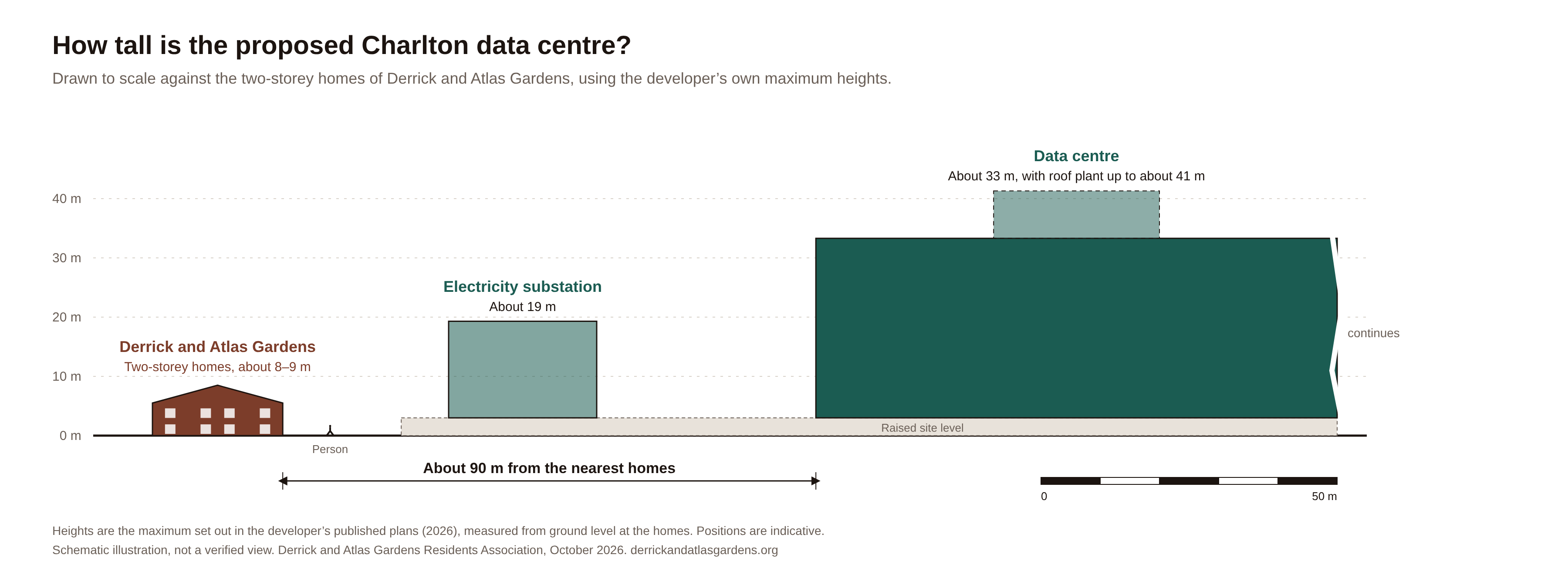
GLi, a joint venture between KSP (Kingston Space Property) and PATRIZIA AG, a German institutional asset manager, is proposing to build a hyperscale data centre of 182 MVA of critical IT capacity on the V.I.P. Industrial Estate, Charlton Riverside SE7. The facility would be approximately 30 metres tall — roughly three to four times the height of the Edwardian homes it would stand beside.
Scale comparison — approximate
A hyperscale data centre typically requires structures of 25 to 35 metres to house cooling plant, generators, switchgear and technical equipment. The Edwardian homes at Derrick and Atlas Gardens are two storeys. The building would be visible across the Charlton Riverside and from elevated vantage points including Blackheath and Greenwich Park.
The proposal is at pre-application stage. GLi conducted a community consultation between 28 November and 21 December 2025. No formal planning application has been submitted to the Royal Borough of Greenwich as of the date this page was published.
The V.I.P. Industrial Estate is allocated for housing-led mixed-use development under the Charlton Riverside Masterplan Supplementary Planning Document (2017). The London Plan identifies the wider Charlton Riverside as an Opportunity Area with a target of 8,000 new homes and 1,000 new jobs by 2041.
Why DAGRA is opposing it
Our Position
DAGRA does not oppose development on the V.I.P. Industrial Estate. We actively support the delivery of housing-led mixed-use development on this site, in the form envisaged by the adopted Masterplan. What we oppose is the permanent displacement of that adopted allocation by a speculative hyperscale data centre that conflicts with every layer of the planning policy framework applicable to this site.
Our formal evidence base sets out 22 independent planning grounds. The five main areas of concern are as follows.
1 · Planning Policy and Land Use
The V.I.P. Industrial Estate has been allocated for housing-led mixed-use development since the adoption of the Charlton Riverside Masterplan SPD in 2017. A hyperscale data centre is not a housing-led use. No very special circumstances have been demonstrated to justify departing from the adopted allocation. If approved, the data centre would permanently recalibrate land values across the Charlton Riverside.
2 · Heritage and the Conservation Area
Our neighbourhood was formally designated as part of the Charlton Riverside Conservation Area in 2018. The Conservation Area Character Appraisal identifies building heights of 2 to 3 storeys as central to the area's special character. A 30-metre industrial structure on the eastern boundary of the Conservation Area would cause irreversible harm to that character — harm that planning law requires to be given considerable importance and weight.
3 · Environmental Assessment
No PFAS contamination baseline has been conducted. No cumulative noise assessment has been carried out for a neighbourhood already burdened by five simultaneous industrial noise sources. No flood risk sequential test has been submitted for a Flood Zone 3 site. No ecological survey or bat survey has been disclosed. No lifecycle carbon assessment has been produced, despite direct conflict with RBG's adopted commitment to carbon neutrality.
4 · Community Health and Safety
The 74 properties at Derrick and Atlas Gardens are built on Thames alluvial ground with a documented history of subsidence. The resident population includes people living with serious health conditions. The proposed development would add a sixth continuous industrial noise source to a neighbourhood already carrying one of the highest cumulative noise burdens in south-east London. None of this has been assessed.
What a data centre diesel generator sounds like — 85 to 100 dB
A single generator running at operational load. A hyperscale data centre of 182 MVA requires approximately 50 to 70 generators of this type running simultaneously, with no mandated operating hours restrictions. Video: generatorsource.com / @generatorsource.
5 · Critical National Infrastructure Concentration
Within approximately five kilometres of Derrick and Atlas Gardens lie four confirmed Critical National Infrastructure assets: the Thames Barrier, London City Airport, the New Cross Grid Supply Point, and Crossness Sewage Treatment Works. A hyperscale data centre would create a five-asset CNI concentration across four national infrastructure sectors, centred on a residential community of 74 homes. The security and resilience implications have not been assessed.
Current status
What has happened so far
Campaign milestones — last updated 2 April 2026
GLi conducted a community consultation from 28 November to 21 December 2025. No formal planning application has been submitted.
On 2 April 2026, DAGRA, Charlton Together and the Charlton Central Residents' Association jointly submitted a pre-application planning evidence base to the Royal Borough of Greenwich Planning Department — 22 planning grounds, 52 references, draft Section 106 heads of terms.
The submission was distributed on 2 April 2026 to Charlton ward councillors, Matthew Pennycook MP, Lord Duvall AM (London Assembly, Woolwich), the Environment Agency, Historic England, Natural England, and the National Protective Security Authority. Both the evidence base and the covering letter are available to download below.
No application has been validated on the RBG planning portal as of the date of this page. DAGRA will update this page when an application is submitted and when the consultation period opens.
A Pre-Application Planning Evidence Base: The GLi Charlton Gateway Proposal
DAGRA, Charlton Together and CCRA · 2 April 2026 · 22 planning grounds · 52 references
Covering Letter: GLi Charlton Gateway Pre-Application Submission
DAGRA, Charlton Together and CCRA · 2 April 2026 · Submitted to RBG Planning, distributed to ward councillors, MP, London Assembly, statutory consultees
You do not need to do anything yet. No formal planning application has been submitted and the statutory consultation period has not begun. When an application is validated and appears on the RBG planning portal, a formal objection period will open. We will notify all residents through this website and the notice board.
Register on the RBG planning portal to receive alerts when an application for the V.I.P. Industrial Estate is registered. Search for the site address: V.I.P. Industrial Estate, Anchor and Hope Lane, Charlton SE7.
Write to your ward councillors and to Matthew Pennycook MP to put your concerns on the record. Contact details are available from DAGRA.
Attend DAGRA meetings. Dates will be published in the Events section when confirmed.
Reading Room
Articles & Archive
History
Our Homes, Our History: Derrick and Atlas Gardens Since 1908
Built in 1908 by William Cory and Son, Derrick and Atlas Gardens are among the most historically significant worker housing estates in south-east London. This is the story of where we live.
Read more →
Planning
Conservation Area Status: What It Means for Our Homes
The 2018 designation of the Charlton Riverside Conservation Area formally recognised the historic character of our streets — and strengthens protections for our community.
Read more →
Planning
The Charlton Riverside Masterplan: What It Promises and Why It Matters
The Charlton Riverside Masterplan SPD, adopted in 2017, allocates the land surrounding our homes for new housing. It sets strict height, density and design requirements. It cost £854,000 of public money to produce.
Read more →
Photograph coming soon
Our Neighbourhood
The Thames Barrier: Our Nearest Neighbour on the River
A ten-minute walk along the Thames Path from Anchor and Hope Lane, the Thames Barrier is one of the great engineering achievements of the twentieth century — and one of the most important structures in London.
Read more →
Campaign — Completed
The Rockwell Campaign: How We Won
From 2016 to 2020, DAGRA and Charlton Together opposed plans for a multi-storey development immediately surrounding our homes. The scheme was refused at council, Mayor and Planning Inspectorate level. This is how it happened.
Read more →
History
Our Homes, Our History: Derrick and Atlas Gardens Since 1908
Built in 1908 by the coal and lighterage company William Cory and Son, Derrick and Atlas Gardens are among the most historically significant worker housing estates in south-east London. This is the story of where we live.
The houses at Derrick and Atlas Gardens were built in 1908 by William Cory and Son, one of the largest coal and lighterage companies in Victorian and Edwardian London. The company operated coal trans-shipment on the River Thames from the site immediately adjacent to the houses. Floating coal berths called the Atlas and the Derrick unloaded collier ships arriving from the North East coalfields and transferred their cargo into Thames barges for distribution upriver. At its peak, the operation discharged over one million tons of coal per annum. The estate was named after those barges. The houses were built to shelter the men who worked them.
The estate was acquired by the Royal Borough of Greenwich in 1983 and remains under council freehold. In 2018, following a campaign in which DAGRA played an active part, the estate was formally included in the new Charlton Riverside Conservation Area. The Conservation Area Character Appraisal, adopted in March 2021, describes Derrick and Atlas Gardens as a rare surviving example of Edwardian social housing, and lists the properties as Local Heritage Assets.
The company that built these homes, William Cory and Son, eventually became the Cory Group. Its corporate successor is today developing the Riverside Heat Network at Belvedere, a 60MW low-carbon district heating scheme serving up to 21,000 homes in the London Borough of Bexley and the Royal Borough of Greenwich. The company that built the estate is, through its successor, now helping to build the infrastructure that may one day heat it.
We have been here for 117 years. We intend to be here for many more.
Planning
Conservation Area Status: What It Means for Our Homes
The Charlton Riverside Conservation Area was formally designated on 21 March 2018. This article explains what that designation means, what protections it provides, and why DAGRA fought for it.
A Conservation Area is a place of special architectural or historic interest whose character it is desirable to preserve or enhance. Designation does not freeze a place in time — but it does place legal obligations on anyone proposing to develop within it or on its setting.
The Charlton Riverside Conservation Area encompasses Derrick and Atlas Gardens and the surrounding riverside landscape. The Character Appraisal, adopted in March 2021, identifies the area's distinctive qualities: its Edwardian terraced housing of two to three storeys; a compact, quiet and secluded character; a strong visual connection with the River Thames; and Derrick and Atlas Gardens as a rare surviving example of Edwardian social housing.
The Character Appraisal specifically names the V.I.P. Trading Estate as the eastern boundary of the Conservation Area. It includes two protected Fixed Views, FV1 and FV2, which look directly into the Gardens from Anchor and Hope Lane. These views are legally protected.
The Character Appraisal also notes that development proposals within the setting of the Conservation Area — especially adjacent to Derrick and Atlas Gardens — will need to have regard to the low-rise, intimate character of the area. This is a direct policy obligation on any developer proposing to build on the V.I.P. Industrial Estate.
DAGRA campaigned actively for the Conservation Area designation. It remains one of the most important protections our neighbourhood has.
Planning
The Charlton Riverside Masterplan: What It Promises and Why It Matters
The Charlton Riverside Masterplan SPD, adopted in 2017, allocates the land surrounding our homes for new housing. It sets strict height, density and design requirements that any developer must follow. It cost the public £854,000 to produce.
The Charlton Riverside Masterplan Supplementary Planning Document was adopted by the Royal Borough of Greenwich in 2017, following extensive consultation with residents, community organisations and the borough itself. It cost £854,000 of public money to develop.
The Masterplan allocates the V.I.P. Industrial Estate for housing-led mixed-use development. It sets height limits of three to six storeys across the majority of the allocation. It establishes design principles that explicitly require new development to respect the setting of the Edwardian estate at Derrick and Atlas Gardens.
The weight of the Masterplan was confirmed at the highest level in June 2020, when the Secretary of State dismissed an appeal for a residential development on the V.I.P. Industrial Estate on the grounds that it conflicted with the SPD. The Secretary of State described the document as "well considered and robust, and also a carefully crafted and well-informed document."
Any developer proposing to depart from the Masterplan's housing-led allocation must demonstrate very special circumstances justifying that departure. To date, GLi has not done so.
The London Plan (2021) sets a target of 8,000 new homes and 1,000 new jobs for the Charlton Riverside Opportunity Area by 2041. The V.I.P. Industrial Estate is one of the last significant parcels of allocated housing land that can make a meaningful contribution to delivering it.
Campaign — Completed 2020
The Rockwell Campaign: How We Won
From 2016 to 2020, DAGRA and Charlton Together opposed plans for a multi-storey residential development immediately surrounding our homes. The scheme was refused at council, Mayor of London, and Planning Inspectorate level. This is how it happened — and why it matters now.
In 2016, Rockwell Property submitted plans for a substantial residential development on the V.I.P. Industrial Estate, immediately to the east of Derrick and Atlas Gardens. The proposed heights and massing were significantly greater than those envisaged by the Charlton Riverside Masterplan SPD, which had been adopted the previous year.
DAGRA, working alongside Charlton Together and other community organisations, mounted a sustained four-year campaign opposing the scheme at every stage of the planning process. The campaign argued that the proposed development conflicted with the adopted Masterplan allocation, would cause harm to the character and setting of the Conservation Area, and was contrary to the height and design principles the borough had spent £854,000 to establish.
The scheme was refused by the Royal Borough of Greenwich planning committee. The developer appealed. The Mayor of London considered the scheme and did not support it. The appeal was ultimately dismissed by the Planning Inspectorate on 3 June 2020. The Inspector confirmed that the Charlton Riverside Masterplan SPD is a material consideration of significant weight, and that the proposed development conflicted with it.
The Secretary of State's decision described the SPD as "well considered and robust, and also a carefully crafted and well-informed document." That description — and that precedent — remains in force. It is directly relevant to any proposal that seeks to depart from the Masterplan's housing-led allocation for the V.I.P. Industrial Estate.
The Rockwell campaign demonstrated that organised, evidence-based community action can succeed at every level of the planning system. DAGRA carries that experience into the current campaign against the GLi Charlton Gateway proposal.
Our Neighbourhood
The Thames Barrier: Our Nearest Neighbour on the River
A ten-minute walk west along the Thames Path from Anchor and Hope Lane, the Thames Barrier rises from the river with an unmistakable presence. It is one of the great engineering achievements of the twentieth century and one of the most important structures in London.
The Thames Barrier from Charlton Riverside path, looking east towards Canary Wharf. Photograph: Selina Johnson.
The Thames Barrier is the flood defence that stands between London and the tidal surge of the North Sea. Construction began in 1974 and took eight years to complete. The Barrier was opened by Her Majesty Queen Elizabeth II on 8 May 1982. At the time of its completion it was the world’s largest moveable flood barrier — a distinction it held for more than two decades — and it remains among the largest such structures anywhere on earth. It stretches 520 metres across the river. When its steel gates are raised, each one stands as tall as a five-storey building.
Looking west along Woolwich Reach from Charlton Riverside. Photograph: Selina Johnson.
The Barrier protects approximately 125 square kilometres of central and east London from tidal flooding, covering the homes and workplaces of roughly 1.25 million people, as well as much of the capital’s most significant built heritage: the Palace of Westminster, the City of London, Canary Wharf, the South Bank, and large parts of Southwark and Newham. Since becoming fully operational, it has been raised more than 200 times. Climate change is accelerating the frequency: the Barrier was raised once in its first decade of operation but has been raised more than 180 times since 2000 as storm surges and tidal levels have intensified.
Through the piers at sunset. Canary Wharf is visible in the centre distance. Photograph: Selina Johnson.
From Derrick and Atlas Gardens, the Barrier is your closest significant landmark along the river. Walk west along the Thames Path from Anchor and Hope Lane and you will reach it in around ten minutes. On a clear day, its characteristic silver hoods are visible from the riverbank before you arrive. It is a remarkable sight — especially at high tide or in low autumn light, when the scale of the structure and the breadth of the river come together in a way that is genuinely striking.
South elevation of the Thames Barrier, Woolwich Reach. Architectural illustration drawn for the DAGRA community website.
The Thames Barrier hoods at dusk from Charlton Riverside. Photograph: Selina Johnson.
The Thames Barrier is formally classified as Critical National Infrastructure. This means it is designated as an asset whose continued, uninterrupted operation is considered essential to the safety and functioning of the country. It is one of four such assets within approximately five kilometres of Derrick and Atlas Gardens — a concentration that is relevant to the planning assessment of any major development proposed in this part of Charlton Riverside.
Start Blackheath & Greenwich Park, 9:30am · Course passes east through Charlton and Woolwich before turning west · Road closures will affect Anchor and Hope Lane and surrounding area — plan journeys in advance · londonmarathonevents.co.uk
Charlton Riverside Conservation Area · Royal Borough of Greenwich
Our homes. Our community. Since 1908.
The community website for residents of Derrick Gardens and Atlas Gardens, Anchor & Hope Lane, Charlton SE7.
Active Campaign · 2025 to present
GLi Charlton Gateway: A Proposed Hyperscale Data Centre
A proposed 182 MVA hyperscale data centre on the land allocated for our neighbourhood's future. DAGRA, Charlton Together and CCRA have formally opposed the proposal. No application has been submitted.
Campaign · Neighbourhood Briefing
The GLi Charlton Gateway Proposal — What You Need to Know
A plain-language guide to the proposed data centre, DAGRA's position, and what residents can do. 12 pages.
This is the new home for residents of Derrick Gardens and Atlas Gardens. The notice board is open to all residents. Share news, ask questions, and stay informed.
Welcome
DAGRA Committee · 2 April 2026
Planning
DAGRA submits formal evidence base opposing GLi data centre proposal
Today DAGRA, Charlton Together and CCRA submitted a pre-application planning evidence base to RBG — 22 planning grounds, 52 references, 8 proposed Section 106 obligations.
GLiPlanningCharlton Gateway
DAGRA Committee · 2 April 2026
Community
Could you help us document the history of our streets?
We are looking for old photographs, documents or memories connected to Derrick Gardens and Atlas Gardens. Please get in touch if you can help.
HistoryCommunity
DAGRA · 2 April 2026
Historic photograph
Our History
Our Homes, Our History
Built in 1908 by the coal and lighterage company William Cory & Son, Atlas and Derrick Gardens are among the most historically significant worker housing estates in south-east London.
The estate takes its name from the company's coal trans-shipment operation on the Thames. Floating coal berths called the Atlas and the Derrick unloaded collier ships arriving from the North East coalfields and transferred their cargo into Thames barges. The houses were built to shelter the men who worked them.
The estate was acquired by Greenwich Council in 1983. In 2018 it was formally included in the new Charlton Riverside Conservation Area, a designation our community actively campaigned for.
Community
Share your photographs
We are building a photographic record of Derrick Gardens, Atlas Gardens and the wider Charlton Riverside — past and present. If you have photographs of the estate, the river, the area or the people who have lived here, we would love to hear from you.
All photographs will be credited and displayed with your permission. You can withdraw consent at any time.
About DAGRA: The Derrick & Atlas Gardens Residents Association represents all residents of Derrick Gardens and Atlas Gardens SE7. We are not-for-profit and run entirely by volunteers. We work alongside Charlton Together and the Charlton Central Residents' Association (CCRA) on planning and community matters. The Charlton Society is an associated organisation.
Community
Notice Board
Community Notice
Welcome to the DAGRA community website
This is the new home for residents of Derrick Gardens and Atlas Gardens, Anchor & Hope Lane, Charlton SE7. The notice board is open to all residents. You can post questions, share local information, or flag issues that affect the neighbourhood. We are launching this site at a significant moment — on the same day, DAGRA and partner organisations have submitted a formal pre-application planning evidence base to RBG opposing the GLi Charlton Gateway data centre proposal. The site will grow over the coming weeks. If you have photographs, memories or documents connected to the history of Derrick and Atlas Gardens, we would very much like to hear from you.
Welcome
DAGRA Committee · 2 April 2026
Planning
DAGRA submits formal evidence base opposing GLi data centre proposal
Today, DAGRA, Charlton Together and the Charlton Central Residents' Association formally submitted a pre-application planning evidence base to the Royal Borough of Greenwich Planning Department. The submission opposes the GLi Charlton Gateway proposal for a 182 MVA hyperscale data centre on the V.I.P. Industrial Estate — the land allocated for housing under the adopted Charlton Riverside Masterplan. The document sets out 22 independent planning grounds across five areas: planning policy and land use, heritage and character, environmental impact, employment and economic claims, and community health, safety and wellbeing. It includes 52 references, draft Section 106 heads of terms, and suggested pre-validation scoping questions. No formal planning application has been submitted by GLi. We will update residents through this notice board when an application is registered and when the formal objection period opens.
GLiPlanningCharlton Gateway
DAGRA Committee · 2 April 2026
Community
Could you help us document the history of our streets?
We are looking for old photographs, documents or memories connected to Derrick Gardens and Atlas Gardens. Whether you have photographs from the early years of the estate, from the Cory industrial period, or from any time since, we would very much like to hear from you. All contributions will be credited and displayed with your permission. Please get in touch using the contact form or by emailing hello@derrickandatlasgardens.org.
HistoryCommunity
DAGRA · 2 April 2026
No posts match your search.
Post to the Notice Board
All posts are reviewed by the DAGRA committee before publication. We aim to publish within 48 hours. Posts should be relevant to residents of Derrick Gardens and Atlas Gardens. DAGRA reserves the right to decline posts that are commercially motivated, defamatory, or unrelated to the community.
Thank you — your post has been received. The DAGRA committee will review it and aim to publish within 48 hours. You will receive an email confirmation shortly.
Active Campaign · 2025 to present
GLi Charlton Gateway: A Proposed Hyperscale Data Centre
A developer called GLi is proposing a 182 MVA hyperscale data centre on the V.I.P. Industrial Estate, Anchor and Hope Lane, Charlton SE7 — land allocated for housing-led mixed-use development under the adopted Charlton Riverside Masterplan. No formal planning application has been submitted as of 2 April 2026. DAGRA, Charlton Together and the Charlton Central Residents' Association have formally opposed the proposal.
What is being proposed
The Proposal
GLi, a joint venture between KSP (Kingston Space Property) and PATRIZIA AG, a German institutional asset manager, is proposing to build a hyperscale data centre of 182 MVA of critical IT capacity on the V.I.P. Industrial Estate, Charlton Riverside SE7. The facility would be approximately 30 metres tall — roughly three to four times the height of the Edwardian homes it would stand beside.
Scale comparison — approximate
A hyperscale data centre typically requires structures of 25 to 35 metres to house cooling plant, generators, switchgear and technical equipment. The Edwardian homes at Derrick and Atlas Gardens are two storeys. The building would be visible across the Charlton Riverside and from elevated vantage points including Blackheath and Greenwich Park.
The proposal is at pre-application stage. GLi conducted a community consultation between 28 November and 21 December 2025. No formal planning application has been submitted to the Royal Borough of Greenwich as of the date this page was published.
The V.I.P. Industrial Estate is allocated for housing-led mixed-use development under the Charlton Riverside Masterplan Supplementary Planning Document (2017). The London Plan identifies the wider Charlton Riverside as an Opportunity Area with a target of 8,000 new homes and 1,000 new jobs by 2041.
Why DAGRA is opposing it
Our Position
DAGRA does not oppose development on the V.I.P. Industrial Estate. We actively support the delivery of housing-led mixed-use development on this site, in the form envisaged by the adopted Masterplan. What we oppose is the permanent displacement of that adopted allocation by a speculative hyperscale data centre that conflicts with every layer of the planning policy framework applicable to this site.
Our formal evidence base sets out 22 independent planning grounds. The five main areas of concern are as follows.
1 · Planning Policy and Land Use
The V.I.P. Industrial Estate has been allocated for housing-led mixed-use development since the adoption of the Charlton Riverside Masterplan SPD in 2017. A hyperscale data centre is not a housing-led use. No very special circumstances have been demonstrated to justify departing from the adopted allocation. If approved, the data centre would permanently recalibrate land values across the Charlton Riverside.
2 · Heritage and the Conservation Area
Our neighbourhood was formally designated as part of the Charlton Riverside Conservation Area in 2018. The Conservation Area Character Appraisal identifies building heights of 2 to 3 storeys as central to the area's special character. A 30-metre industrial structure on the eastern boundary of the Conservation Area would cause irreversible harm to that character — harm that planning law requires to be given considerable importance and weight.
3 · Environmental Assessment
No PFAS contamination baseline has been conducted. No cumulative noise assessment has been carried out for a neighbourhood already burdened by five simultaneous industrial noise sources. No flood risk sequential test has been submitted for a Flood Zone 3 site. No ecological survey or bat survey has been disclosed. No lifecycle carbon assessment has been produced, despite direct conflict with RBG's adopted commitment to carbon neutrality.
4 · Community Health and Safety
The 74 properties at Derrick and Atlas Gardens are built on Thames alluvial ground with a documented history of subsidence. The resident population includes people living with serious health conditions. The proposed development would add a sixth continuous industrial noise source to a neighbourhood already carrying one of the highest cumulative noise burdens in south-east London. None of this has been assessed.
What a data centre diesel generator sounds like — 85 to 100 dB
A single generator running at operational load. A hyperscale data centre of 182 MVA requires approximately 50 to 70 generators of this type running simultaneously, with no mandated operating hours restrictions. Video: generatorsource.com / @generatorsource.
5 · Critical National Infrastructure Concentration
Within approximately five kilometres of Derrick and Atlas Gardens lie four confirmed Critical National Infrastructure assets: the Thames Barrier, London City Airport, the New Cross Grid Supply Point, and Crossness Sewage Treatment Works. A hyperscale data centre would create a five-asset CNI concentration across four national infrastructure sectors, centred on a residential community of 74 homes. The security and resilience implications have not been assessed.
Current status
What has happened so far
Campaign milestones — last updated 2 April 2026
GLi conducted a community consultation from 28 November to 21 December 2025. No formal planning application has been submitted.
On 2 April 2026, DAGRA, Charlton Together and the Charlton Central Residents' Association jointly submitted a pre-application planning evidence base to the Royal Borough of Greenwich Planning Department — 22 planning grounds, 52 references, draft Section 106 heads of terms.
The submission was distributed on 2 April 2026 to Charlton ward councillors, Matthew Pennycook MP, Lord Duvall AM (London Assembly, Woolwich), the Environment Agency, Historic England, Natural England, and the National Protective Security Authority. Both the evidence base and the covering letter are available to download below.
No application has been validated on the RBG planning portal as of the date of this page. DAGRA will update this page when an application is submitted and when the consultation period opens.
A Pre-Application Planning Evidence Base: The GLi Charlton Gateway Proposal
DAGRA, Charlton Together and CCRA · 2 April 2026 · 22 planning grounds · 52 references
Covering Letter: GLi Charlton Gateway Pre-Application Submission
DAGRA, Charlton Together and CCRA · 2 April 2026 · Submitted to RBG Planning, distributed to ward councillors, MP, London Assembly, statutory consultees
You do not need to do anything yet. No formal planning application has been submitted and the statutory consultation period has not begun. When an application is validated and appears on the RBG planning portal, a formal objection period will open. We will notify all residents through this website and the notice board.
Register on the RBG planning portal to receive alerts when an application for the V.I.P. Industrial Estate is registered. Search for the site address: V.I.P. Industrial Estate, Anchor and Hope Lane, Charlton SE7.
Write to your ward councillors and to Matthew Pennycook MP to put your concerns on the record. Contact details are available from DAGRA.
Attend DAGRA meetings. Dates will be published in the Events section when confirmed.
Reading Room
Articles & Archive
History
Our Homes, Our History: Derrick and Atlas Gardens Since 1908
Built in 1908 by William Cory and Son, Derrick and Atlas Gardens are among the most historically significant worker housing estates in south-east London. This is the story of where we live.
Read more →
Planning
Conservation Area Status: What It Means for Our Homes
The 2018 designation of the Charlton Riverside Conservation Area formally recognised the historic character of our streets — and strengthens protections for our community.
Read more →
Planning
The Charlton Riverside Masterplan: What It Promises and Why It Matters
The Charlton Riverside Masterplan SPD, adopted in 2017, allocates the land surrounding our homes for new housing. It sets strict height, density and design requirements. It cost £854,000 of public money to produce.
Read more →
Photograph coming soon
Our Neighbourhood
The Thames Barrier: Our Nearest Neighbour on the River
A ten-minute walk along the Thames Path from Anchor and Hope Lane, the Thames Barrier is one of the great engineering achievements of the twentieth century — and one of the most important structures in London.
Read more →
Campaign — Completed
The Rockwell Campaign: How We Won
From 2016 to 2020, DAGRA and Charlton Together opposed plans for a multi-storey development immediately surrounding our homes. The scheme was refused at council, Mayor and Planning Inspectorate level. This is how it happened.
Read more →
History
Our Homes, Our History: Derrick and Atlas Gardens Since 1908
Built in 1908 by the coal and lighterage company William Cory and Son, Derrick and Atlas Gardens are among the most historically significant worker housing estates in south-east London. This is the story of where we live.
The houses at Derrick and Atlas Gardens were built in 1908 by William Cory and Son, one of the largest coal and lighterage companies in Victorian and Edwardian London. The company operated coal trans-shipment on the River Thames from the site immediately adjacent to the houses. Floating coal berths called the Atlas and the Derrick unloaded collier ships arriving from the North East coalfields and transferred their cargo into Thames barges for distribution upriver. At its peak, the operation discharged over one million tons of coal per annum. The estate was named after those barges. The houses were built to shelter the men who worked them.
The estate was acquired by the Royal Borough of Greenwich in 1983 and remains under council freehold. In 2018, following a campaign in which DAGRA played an active part, the estate was formally included in the new Charlton Riverside Conservation Area. The Conservation Area Character Appraisal, adopted in March 2021, describes Derrick and Atlas Gardens as a rare surviving example of Edwardian social housing, and lists the properties as Local Heritage Assets.
The company that built these homes, William Cory and Son, eventually became the Cory Group. Its corporate successor is today developing the Riverside Heat Network at Belvedere, a 60MW low-carbon district heating scheme serving up to 21,000 homes in the London Borough of Bexley and the Royal Borough of Greenwich. The company that built the estate is, through its successor, now helping to build the infrastructure that may one day heat it.
We have been here for 117 years. We intend to be here for many more.
Planning
Conservation Area Status: What It Means for Our Homes
The Charlton Riverside Conservation Area was formally designated on 21 March 2018. This article explains what that designation means, what protections it provides, and why DAGRA fought for it.
A Conservation Area is a place of special architectural or historic interest whose character it is desirable to preserve or enhance. Designation does not freeze a place in time — but it does place legal obligations on anyone proposing to develop within it or on its setting.
The Charlton Riverside Conservation Area encompasses Derrick and Atlas Gardens and the surrounding riverside landscape. The Character Appraisal, adopted in March 2021, identifies the area's distinctive qualities: its Edwardian terraced housing of two to three storeys; a compact, quiet and secluded character; a strong visual connection with the River Thames; and Derrick and Atlas Gardens as a rare surviving example of Edwardian social housing.
The Character Appraisal specifically names the V.I.P. Trading Estate as the eastern boundary of the Conservation Area. It includes two protected Fixed Views, FV1 and FV2, which look directly into the Gardens from Anchor and Hope Lane. These views are legally protected.
The Character Appraisal also notes that development proposals within the setting of the Conservation Area — especially adjacent to Derrick and Atlas Gardens — will need to have regard to the low-rise, intimate character of the area. This is a direct policy obligation on any developer proposing to build on the V.I.P. Industrial Estate.
DAGRA campaigned actively for the Conservation Area designation. It remains one of the most important protections our neighbourhood has.
Planning
The Charlton Riverside Masterplan: What It Promises and Why It Matters
The Charlton Riverside Masterplan SPD, adopted in 2017, allocates the land surrounding our homes for new housing. It sets strict height, density and design requirements that any developer must follow. It cost the public £854,000 to produce.
The Charlton Riverside Masterplan Supplementary Planning Document was adopted by the Royal Borough of Greenwich in 2017, following extensive consultation with residents, community organisations and the borough itself. It cost £854,000 of public money to develop.
The Masterplan allocates the V.I.P. Industrial Estate for housing-led mixed-use development. It sets height limits of three to six storeys across the majority of the allocation. It establishes design principles that explicitly require new development to respect the setting of the Edwardian estate at Derrick and Atlas Gardens.
The weight of the Masterplan was confirmed at the highest level in June 2020, when the Secretary of State dismissed an appeal for a residential development on the V.I.P. Industrial Estate on the grounds that it conflicted with the SPD. The Secretary of State described the document as "well considered and robust, and also a carefully crafted and well-informed document."
Any developer proposing to depart from the Masterplan's housing-led allocation must demonstrate very special circumstances justifying that departure. To date, GLi has not done so.
The London Plan (2021) sets a target of 8,000 new homes and 1,000 new jobs for the Charlton Riverside Opportunity Area by 2041. The V.I.P. Industrial Estate is one of the last significant parcels of allocated housing land that can make a meaningful contribution to delivering it.
Campaign — Completed 2020
The Rockwell Campaign: How We Won
From 2016 to 2020, DAGRA and Charlton Together opposed plans for a multi-storey residential development immediately surrounding our homes. The scheme was refused at council, Mayor of London, and Planning Inspectorate level. This is how it happened — and why it matters now.
In 2016, Rockwell Property submitted plans for a substantial residential development on the V.I.P. Industrial Estate, immediately to the east of Derrick and Atlas Gardens. The proposed heights and massing were significantly greater than those envisaged by the Charlton Riverside Masterplan SPD, which had been adopted the previous year.
DAGRA, working alongside Charlton Together and other community organisations, mounted a sustained four-year campaign opposing the scheme at every stage of the planning process. The campaign argued that the proposed development conflicted with the adopted Masterplan allocation, would cause harm to the character and setting of the Conservation Area, and was contrary to the height and design principles the borough had spent £854,000 to establish.
The scheme was refused by the Royal Borough of Greenwich planning committee. The developer appealed. The Mayor of London considered the scheme and did not support it. The appeal was ultimately dismissed by the Planning Inspectorate on 3 June 2020. The Inspector confirmed that the Charlton Riverside Masterplan SPD is a material consideration of significant weight, and that the proposed development conflicted with it.
The Secretary of State's decision described the SPD as "well considered and robust, and also a carefully crafted and well-informed document." That description — and that precedent — remains in force. It is directly relevant to any proposal that seeks to depart from the Masterplan's housing-led allocation for the V.I.P. Industrial Estate.
The Rockwell campaign demonstrated that organised, evidence-based community action can succeed at every level of the planning system. DAGRA carries that experience into the current campaign against the GLi Charlton Gateway proposal.
Our Neighbourhood
The Thames Barrier: Our Nearest Neighbour on the River
A ten-minute walk west along the Thames Path from Anchor and Hope Lane, the Thames Barrier rises from the river with an unmistakable presence. It is one of the great engineering achievements of the twentieth century and one of the most important structures in London.
The Thames Barrier from Charlton Riverside path, looking east towards Canary Wharf. Photograph: Selina Johnson.
The Thames Barrier is the flood defence that stands between London and the tidal surge of the North Sea. Construction began in 1974 and took eight years to complete. The Barrier was opened by Her Majesty Queen Elizabeth II on 8 May 1982. At the time of its completion it was the world’s largest moveable flood barrier — a distinction it held for more than two decades — and it remains among the largest such structures anywhere on earth. It stretches 520 metres across the river. When its steel gates are raised, each one stands as tall as a five-storey building.
Looking west along Woolwich Reach from Charlton Riverside. Photograph: Selina Johnson.
The Barrier protects approximately 125 square kilometres of central and east London from tidal flooding, covering the homes and workplaces of roughly 1.25 million people, as well as much of the capital’s most significant built heritage: the Palace of Westminster, the City of London, Canary Wharf, the South Bank, and large parts of Southwark and Newham. Since becoming fully operational, it has been raised more than 200 times. Climate change is accelerating the frequency: the Barrier was raised once in its first decade of operation but has been raised more than 180 times since 2000 as storm surges and tidal levels have intensified.
Through the piers at sunset. Canary Wharf is visible in the centre distance. Photograph: Selina Johnson.
From Derrick and Atlas Gardens, the Barrier is your closest significant landmark along the river. Walk west along the Thames Path from Anchor and Hope Lane and you will reach it in around ten minutes. On a clear day, its characteristic silver hoods are visible from the riverbank before you arrive. It is a remarkable sight — especially at high tide or in low autumn light, when the scale of the structure and the breadth of the river come together in a way that is genuinely striking.
South elevation of the Thames Barrier, Woolwich Reach. Architectural illustration drawn for the DAGRA community website.
The Thames Barrier hoods at dusk from Charlton Riverside. Photograph: Selina Johnson.
The Thames Barrier is formally classified as Critical National Infrastructure. This means it is designated as an asset whose continued, uninterrupted operation is considered essential to the safety and functioning of the country. It is one of four such assets within approximately five kilometres of Derrick and Atlas Gardens — a concentration that is relevant to the planning assessment of any major development proposed in this part of Charlton Riverside.
Start Blackheath & Greenwich Park, 9:30am · Course passes east through Charlton and Woolwich before turning west · Road closures will affect Anchor and Hope Lane and surrounding area — plan journeys in advance · londonmarathonevents.co.uk
DAGRA & Campaign · May 2026 · Date to be announced
DAGRA Annual General Meeting All residents of Derrick Gardens and Atlas Gardens are welcome. Agenda: committee report, GLi Charlton Gateway campaign update, committee elections. Date, time and venue to be confirmed. Email hello@derrickandatlasgardens.org to register.
DAGRA & Campaign · Date to be announced
DAGRA Community Meeting — All Residents Welcome Community meeting for all residents to discuss the GLi Charlton Gateway campaign and answer questions. Date, time and location to be confirmed. Register via the Notice Board or email hello@derrickandatlasgardens.org.
Know of a local event that should be listed here? Contact DAGRA with the details and we will consider adding it to the calendar.
Stay informed
Get updates from DAGRA
Register your email address to receive updates when campaign milestones are reached, when a planning application is submitted, and when community meetings are confirmed. We will never share your details and you can unsubscribe at any time.
Register for updates
Thank you — we have received your details and will be in touch with updates.
About DAGRA
Our Governance
DAGRA is a not-for-profit residents association run entirely by volunteers. This section sets out how we are organised, how decisions are made, and how residents can get involved.
What DAGRA is
The Derrick and Atlas Gardens Residents Association (DAGRA) represents all residents of Derrick Gardens and Atlas Gardens, Anchor and Hope Lane, Charlton SE7. We are a not-for-profit community organisation, run entirely by volunteers and accountable to our residents. We have no paid staff and no commercial interests.
DAGRA was formed to give the residents of this estate a formal voice in matters that affect their homes and neighbourhood: planning decisions, conservation, maintenance, community life and local policy. We work in partnership with Charlton Together, the Charlton Society, Quixotic Records and the Charlton Central Residents' Association.
Current representatives
Acting Chair
Selina Johnson
Vice Chair
Philip Connolly
Secretary
Lindsay Barnett
All residents of Derrick Gardens and Atlas Gardens are members of DAGRA by virtue of living on the estate. There is no membership fee and no registration required. If you would like to join the committee or help with a specific project, please get in touch.
How we are organised
DAGRA is governed by a constitution, which sets out the rules for membership, elections, meetings and decision-making. The committee meets regularly and holds at least one Annual General Meeting each year, open to all residents.
Committee roles include Chair, Secretary and Treasurer as required positions, with optional roles including Vice-Chair, Conservation and Planning Lead, and Events and Community Lead.
Governance documents
Our governing documents are available to all residents. PDF versions will be added shortly.
Who we are. The Derrick and Atlas Gardens Residents Association (DAGRA) is a not-for-profit residents association and the data controller for personal information submitted through this website.
What we collect. Name, email address and the content of messages or post submissions. We do not collect sensitive personal data, payment information or location data beyond what you voluntarily provide.
Why we collect it. To respond to enquiries, to review and publish notice board posts where approved, and to send campaign updates to residents who have registered. We will not use your details for any other purpose.
Your rights. You have the right to access, correct or delete the information we hold about you at any time. To unsubscribe from email updates, email unsubscribeme@derrickandatlasgardens.org. We will action your request within five working days.
Sharing. We will never share, sell or transfer your personal information to any third party. This notice is provided in accordance with the UK GDPR and the Data Protection Act 2018. For information about your rights visit ico.org.uk.
Get in Touch
Contact DAGRA
For questions, concerns or to get involved with the residents association. We aim to reply within a few working days.
We areA residents association representing Derrick Gardens and Atlas Gardens, Anchor & Hope Lane SE7. Not-for-profit, run by volunteers.